 HDElectHeat Electric Duct Heater Calculator
HDElectHeat is a precise desktop tool for sizing and verifying electric duct heaters used in HVAC air-handling and terminal-unit applications. Whether you are selecting a heater for a new system, confirming that an existing unit meets code-required watt-density limits, or checking current draw for panel coordination, HDElectHeat delivers the complete set of electric-heat performance results in seconds.
HDElectHeat handles both common element types and both standard power configurations:
- Open-Coil Elements — bare-wire nichrome resistance elements suspended in the airstream; higher maximum watt density (up to 28.9 kW/sq.ft.) for general duct-heat applications.
- Finned-Tube Elements — resistance wire inside a sheathed, finned tube; lower maximum watt density (up to 17 kW/sq.ft.) with improved element protection, suitable for lower-velocity or higher-temperature applications.
- Single-Phase and Three-Phase — current draw is computed for either configuration from the entered voltage and calculated heater size.
Specify the duct airflow, heater face dimensions, and either the desired leaving-air temperature or the heater size in kilowatts, and HDElectHeat instantly computes the full performance picture, flags any watt-density violations, and reports the absolute maximum heater capacity the duct geometry and airflow will support.
KEY FEATURES
- Computes Temperature Rise and Leaving Air Temperature from airflow and heater kW, or solves for kW from a target leaving temperature.
- Calculates Sensible Heat Output in Btu/hr (IP) or kW (SI) using the standard sensible-heat equation for air.
- Calculates Current Draw (Amps) for single-phase or three-phase power supply at the specified voltage.
- Calculates Air Pressure Drop across the element bank (in. W.C. or Pa) as a function of element-face velocity, for both open-coil and finned-tube element types.
- Computes Watt Density (kW/sq.ft. or kW/sq.m) and compares it against the NEC- and manufacturer-recommended maximum for the selected element type, with a clear pass/fail indication.
- Computes Heater Face Area and Element Face Area (subtracting frame allowances) from the entered height and width dimensions.
- Computes Element Face Velocity and the Minimum Required Element Velocity for the entered watt density and entering-air temperature, so airflow adequacy can be verified in a single glance.
- Reports Maximum Allowable Heater Size (kW) and the corresponding Maximum Leaving Air Temperature for the duct geometry and airflow, giving the designer the full operating envelope.
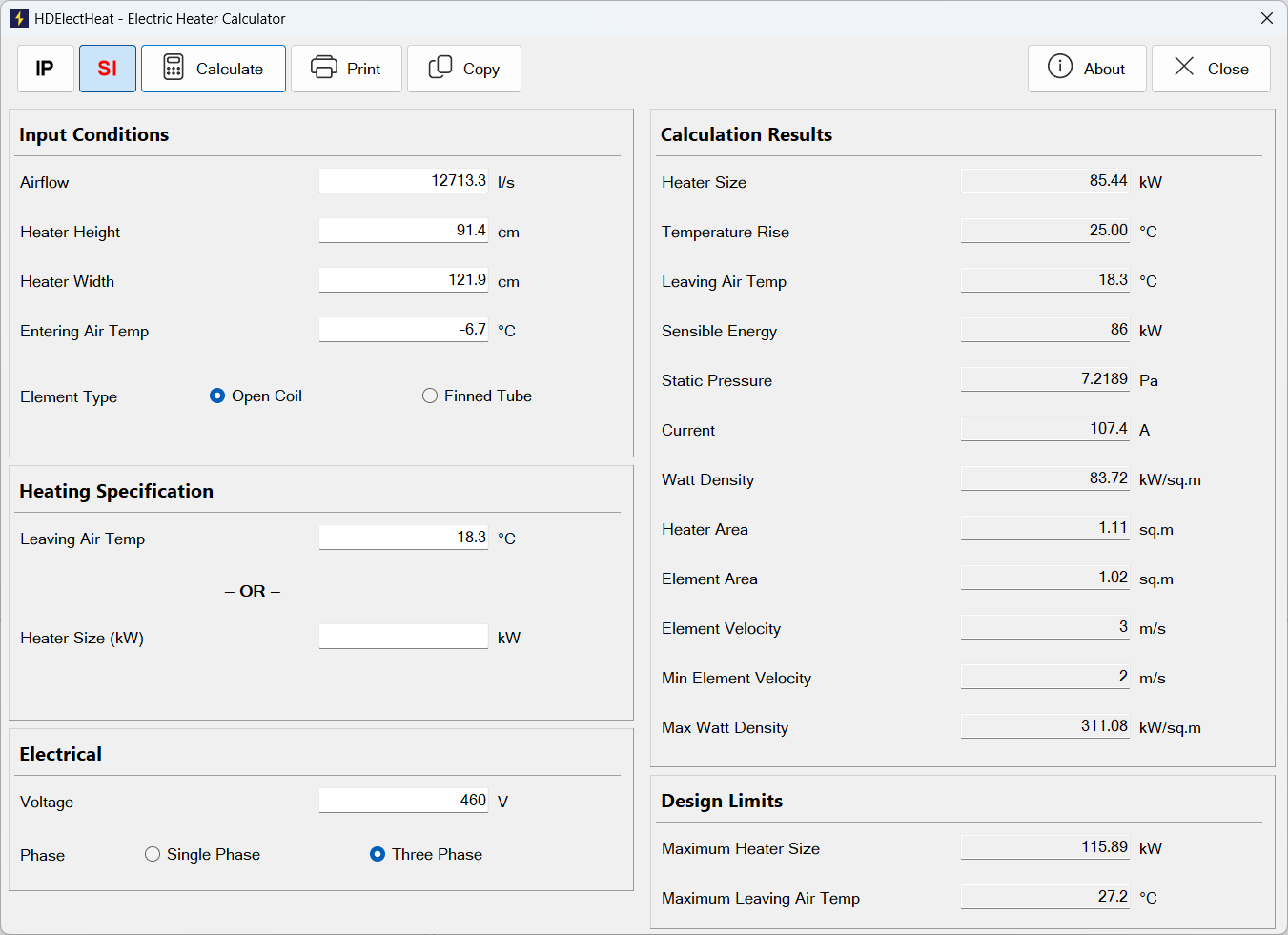
- Full IP and SI unit support — toggle between °F/cfm/in. and °C/l s/cm with a single click; all inputs and results convert automatically.
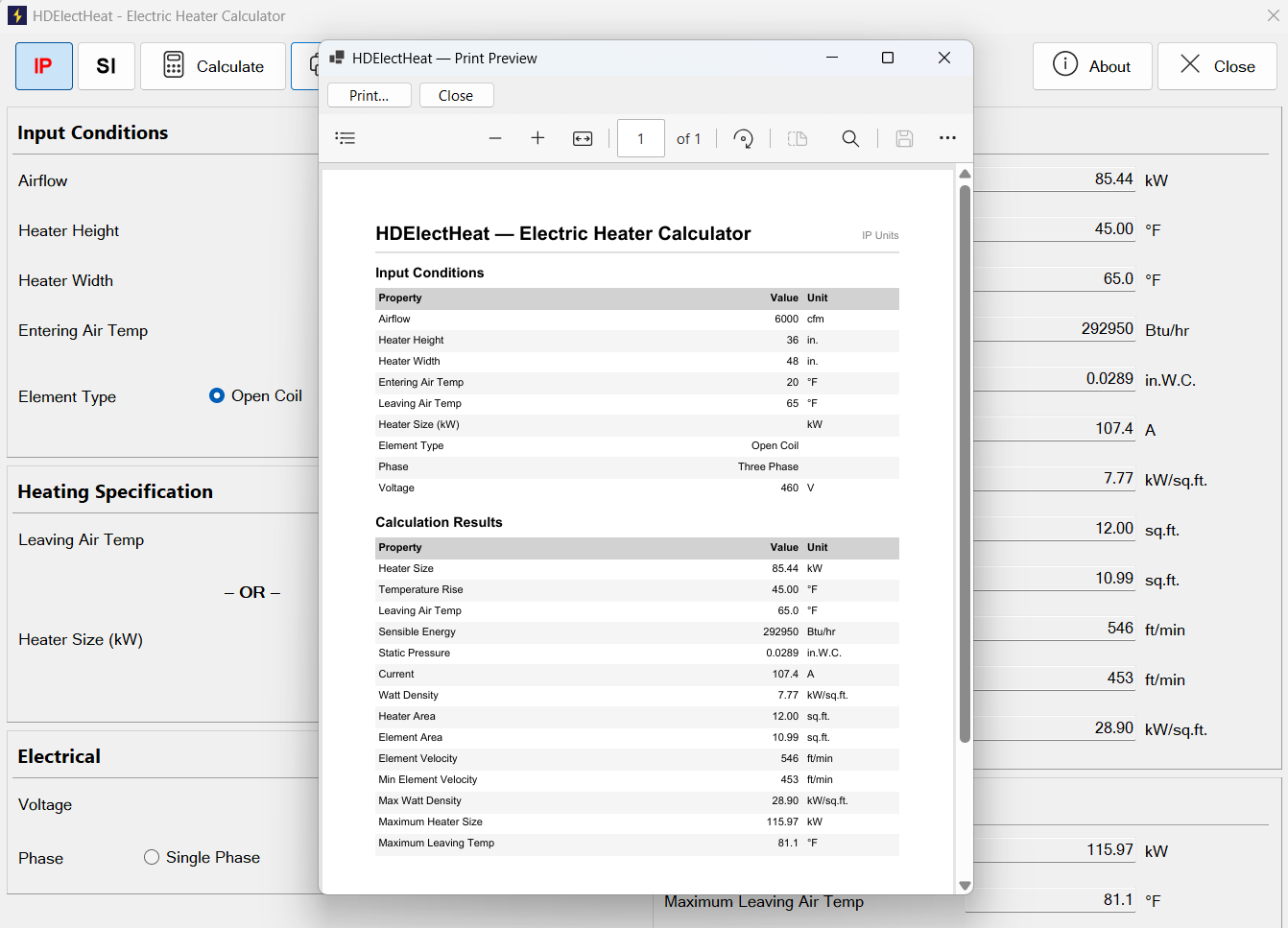
- PDF report generation — produces a cleanly formatted summary of all inputs and results, ready to attach to any project submittal or equipment schedule.
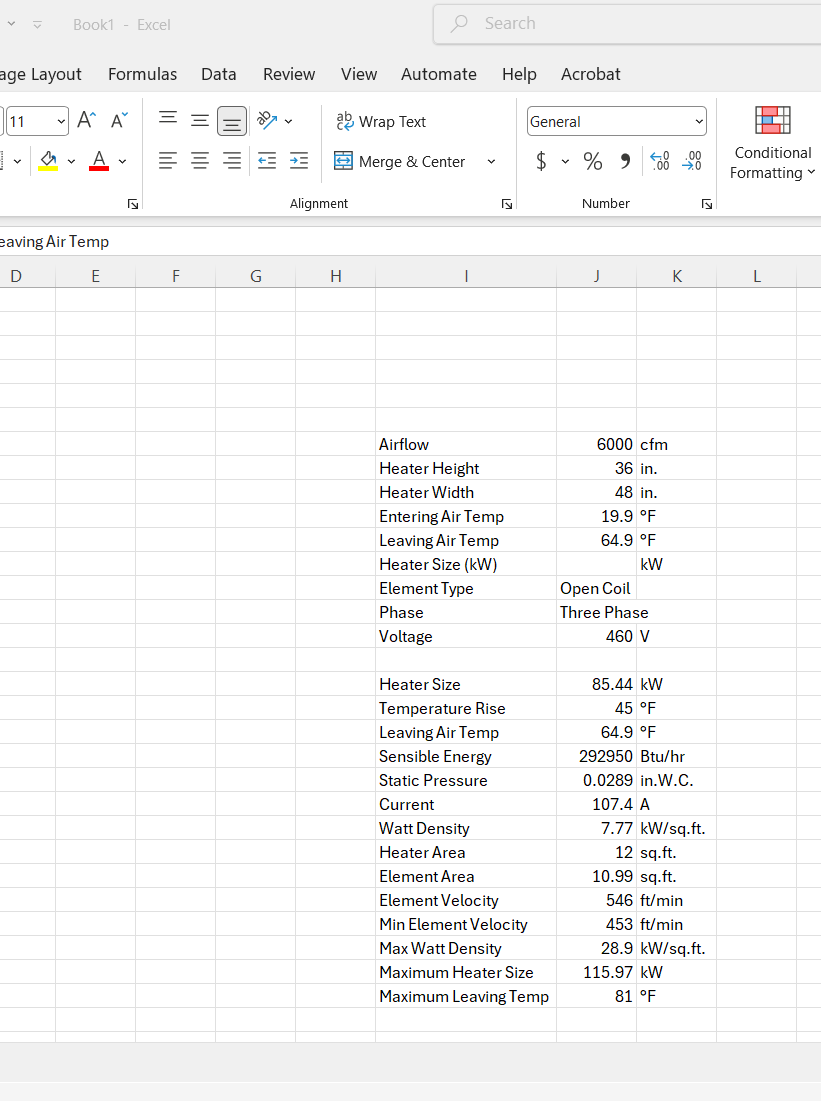
- Clipboard copy — exports all inputs and results as tab-delimited text for pasting directly into spreadsheets or project reports.
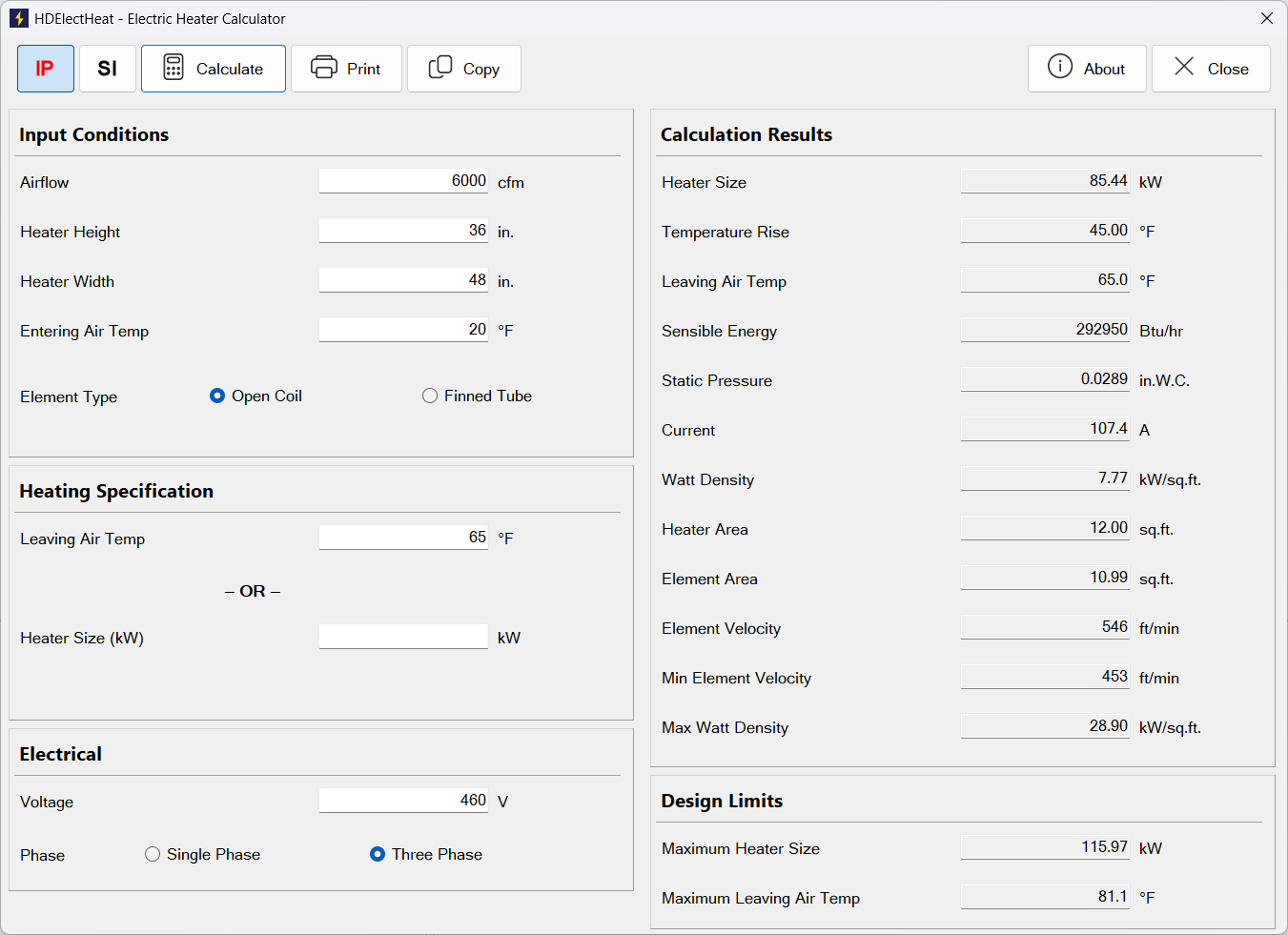
INPUTS
HDElectHeat accepts the following parameters to fully define the electric heater selection:
- Airflow — volumetric flow rate through the heater (cfm or l/s)
- Heater Height — overall face height of the heater casing (in. or cm)
- Heater Width — overall face width of the heater casing (in. or cm); the element face area is computed by subtracting standard frame allowances from both dimensions
- Entering Air Temperature — dry-bulb temperature of the air entering the heater (°F or °C); determines the velocity-limited watt-density curve
- Leaving Air Temperature — target supply-air temperature leaving the heater (°F or °C); enter this or Heater Size, not both
- Heater Size (kW) — installed heater capacity in kilowatts; enter this or Leaving Air Temperature, not both; kW is the same in IP and SI
- Element Type — Open Coil or Finned Tube; controls the watt-density limit and pressure-drop equation used
- Phase — Single Phase or Three Phase; used to compute current draw from voltage and kW
- Voltage — supply voltage (V); common values are 120, 208, 240, 277, 460, or 480 V
RESULTS COMPUTED
HDElectHeat reports the following outputs after each calculation:
- Heater Size — calculated or confirmed heater capacity (kW)
- Temperature Rise — dry-bulb temperature increase across the heater (°F or °C)
- Leaving Air Temperature — calculated or confirmed supply-air temperature (°F or °C)
- Sensible Energy — total heat delivered to the airstream (Btu/hr or kW)
- Static Pressure Drop — resistance of the element bank to airflow (in. W.C. or Pa)
- Current Draw — full-load amperage at the specified voltage and phase (A)
- Watt Density — heater output per unit of element face area (kW/sq.ft. or kW/sq.m); compared against the recommended maximum for the element type
- Heater Face Area — overall face area from the entered dimensions (sq.ft. or sq.m)
- Element Face Area — net element area after subtracting frame allowances (sq.ft. or sq.m)
- Element Face Velocity — actual air velocity through the element face (ft/min or m/s)
- Minimum Element Velocity — lowest velocity required to keep watt density within the safe limit at the computed kW/sq.ft. (ft/min or m/s); element velocity must exceed this value
- Maximum Watt Density — recommended upper limit for the selected element type (kW/sq.ft. or kW/sq.m)
- Maximum Heater Size — largest heater that can be installed in the given duct at the given airflow without exceeding the watt-density limit (kW)
- Maximum Leaving Temperature — supply-air temperature corresponding to the maximum heater size (°F or °C)

System Requirements
- Windows 10 or Windows 11
- .NET 8 Runtime (included in installer)
- 50 MB disk space