 HDThermalComfort ASHRAE 55 Thermal Comfort Calculator
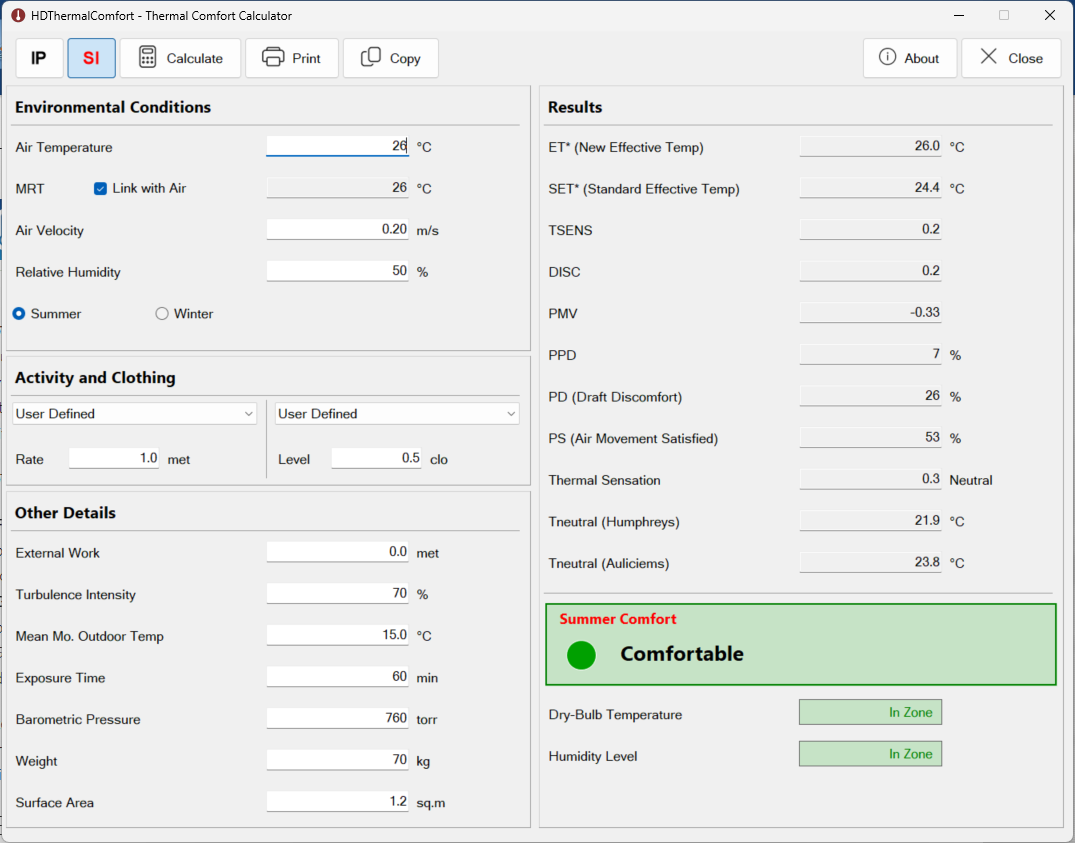
HDThermalComfort is a desktop tool for evaluating the thermal comfort of building occupants in accordance with ASHRAE Standard 55 — the industry standard for thermal environmental conditions for human occupancy. Whether you are designing HVAC systems, performing energy analysis, or verifying occupant comfort, HDThermalComfort delivers a full suite of comfort indices in seconds.
HDThermalComfort implements two complementary calculation models side by side:
- Fanger PMV/PPD Model — the ISO 7730 / ASHRAE 55 steady-state model that predicts the Predicted Mean Vote (PMV) and Predicted Percentage Dissatisfied (PPD) for a group of occupants under given environmental and personal conditions.
- Gagge Two-Node Model — the ASHRAE 781-RP transient model that simulates the body’s core and skin temperatures over time to compute Effective Temperature (ET), Standard Effective Temperature (SET), thermal sensation (TSENS), and thermal discomfort (DISC).
Enter environmental conditions and personal factors and HDThermalComfort instantly computes the complete set of comfort indices, comfort zone assessments, and draft-risk indicators.
KEY FEATURES
- Computes PMV and PPD per the Fanger model (ISO 7730 / ASHRAE 55) for steady-state occupant comfort prediction.
- Computes ET, SET, TSENS, and DISC via the Gagge two-node transient physiological model for time-dependent comfort analysis.
- Evaluates draft risk (PD — Percentage Dissatisfied with draft) and air movement acceptability (PS — Percentage Satisfied with air movement) for the given velocity and turbulence intensity.
- Computes Thermal Sensation Rating (TSR) and adaptive neutral temperatures per the Humphreys and Auliciems models using the mean monthly outdoor temperature.
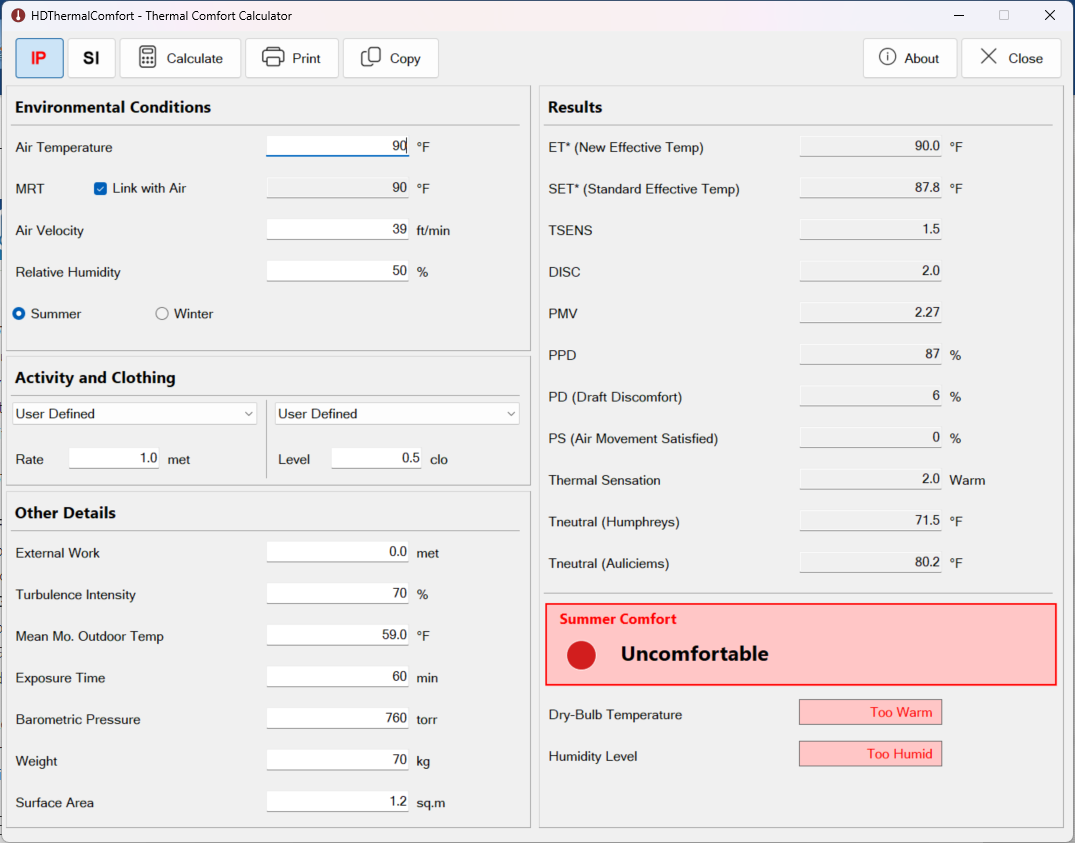
- Assesses occupant conditions against the ASHRAE 55 Summer and Winter Comfort Zones on both the dry-bulb and humidity axes, with color-coded in-zone / too-warm / too-cool / too-dry / too-humid verdicts.
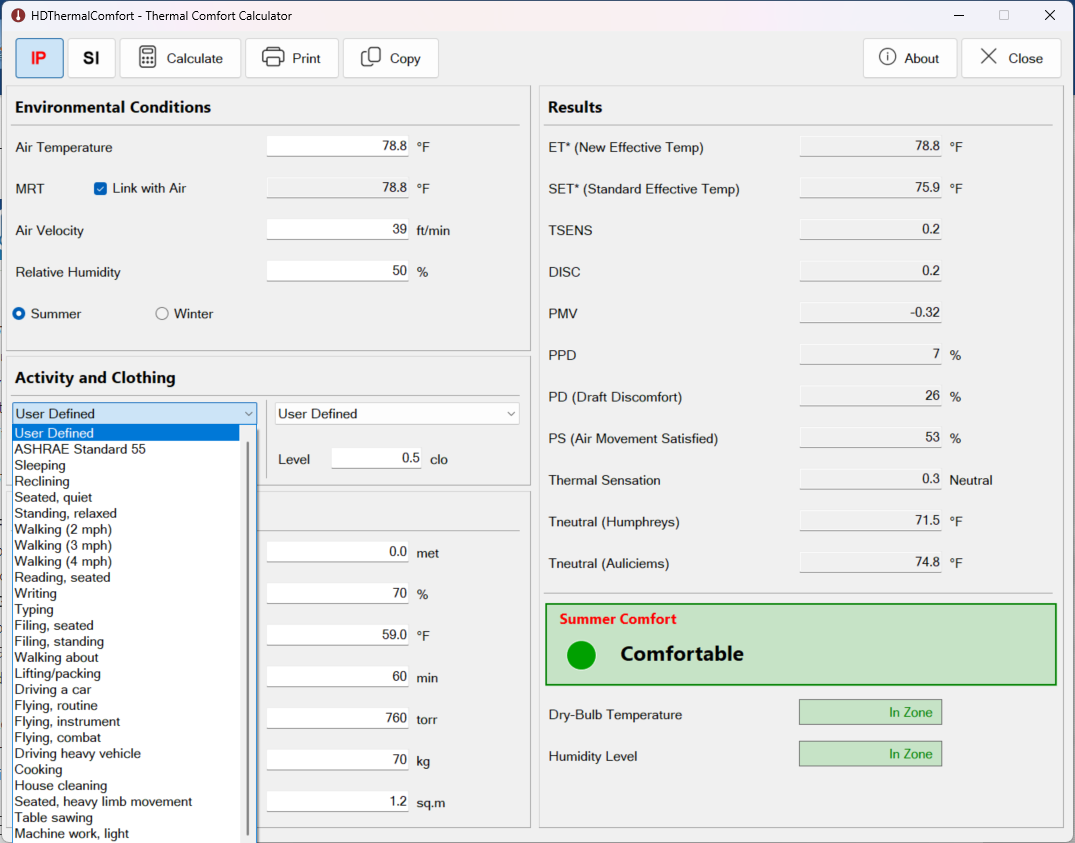
- Built-in Activity Library with preset metabolic rates (MET values) for common occupant activities — resting, seated work, walking, exercise, and more — or enter a custom MET value directly.
- Built-in Clothing Library with preset insulation values (CLO) for standard clothing ensembles — or enter a custom CLO value.
- Full IP and SI unit support — toggle between °F/ft min and °C/m s with a single click; all inputs and results convert automatically.
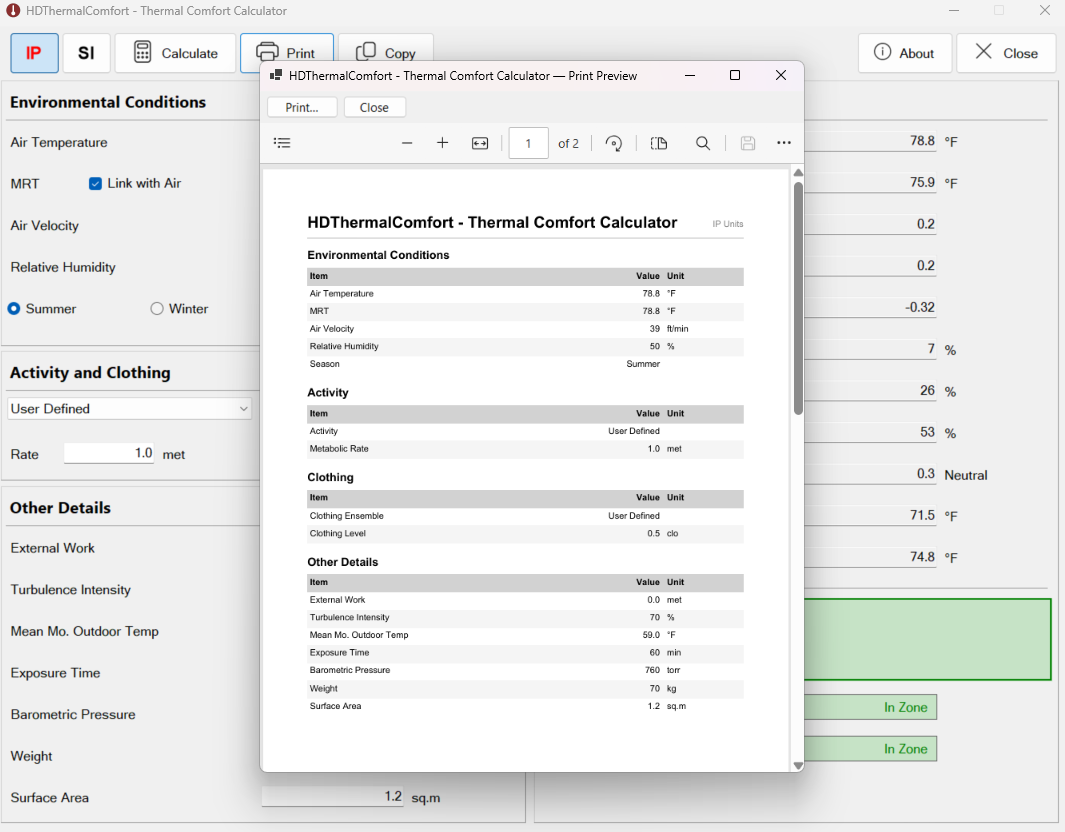
- PDF report generation — produces a cleanly formatted summary of all inputs, computed indices, and comfort zone verdicts, ready to attach to any project submittal.
- Clipboard copy — exports all inputs and results as tab-delimited text for pasting directly into spreadsheets or project reports.
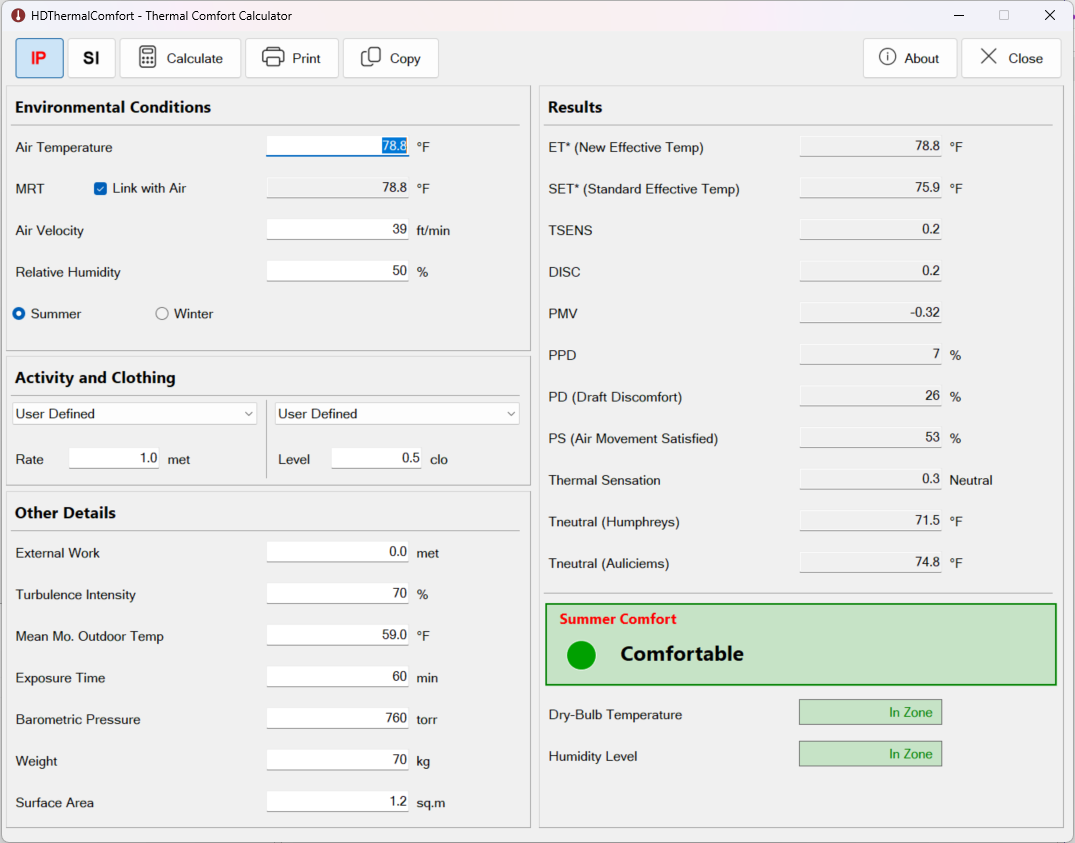
INPUTS
HDThermalComfort accepts the full set of environmental and personal parameters required by both the Fanger and Gagge models:
- Air Temperature — dry-bulb temperature of the ambient air (°F or °C)
- Mean Radiant Temperature (MRT) — area-weighted mean temperature of surrounding surfaces; can be linked to air temperature for uniform-radiation spaces
- Air Velocity — local mean air speed at the occupant (ft/min or m/s)
- Relative Humidity — ambient relative humidity (%)
- Metabolic Rate — occupant activity level in MET units, selected from the activity library or entered directly
- Clothing Insulation — clothing ensemble thermal resistance in CLO, selected from the clothing library or entered directly
- External Work — mechanical work output in MET (typically 0 for most occupancies)
- Turbulence Intensity — air stream turbulence intensity (%) for draft-risk calculation
- Mean Monthly Outdoor Temperature — used by the adaptive Humphreys and Auliciems neutral-temperature models (°F or °C)
- Exposure Time — duration of occupant exposure in minutes for the Gagge transient simulation
- Barometric Pressure — local atmospheric pressure in Torr for altitude corrections
- Body Weight and Surface Area — occupant body mass (kg) and DuBois surface area (m²) for the two-node model
- Season — Summer or Winter, which selects the appropriate ASHRAE 55 comfort zone boundaries
COMFORT INDICES COMPUTED
HDThermalComfort reports the following results after each calculation:
- ET — Effective Temperature: the dry-bulb temperature of a reference environment that produces the same total heat loss from the skin as the actual environment
- SET — Standard Effective Temperature: a standardized ET at a fixed activity level and clothing value, enabling comparison across environments
- TSENS — Thermal Sensation index from the Gagge model (−4 very cold to +4 very hot)
- DISC — Thermal Discomfort index indicating degree of physiological strain (−4 comfortable to +4 intolerable)
- PMV — Predicted Mean Vote on the ASHRAE/ISO thermal sensation scale (−3 cold to +3 hot)
- PPD — Predicted Percentage Dissatisfied (%); minimum ~5% even in neutral conditions
- PD — Percentage Dissatisfied with draft (%)
- PS — Percentage Satisfied with air movement (%)
- TSR — Thermal Sensation Rating for the adaptive comfort assessment
- T Neutral (Humphreys) — adaptive neutral temperature per the Humphreys regression
- T Neutral (Auliciems) — adaptive neutral temperature per the Auliciems regression
- Dry-Bulb Zone Verdict — In Zone / Too Warm / Too Cool, color-coded green / red / blue
- Humidity Zone Verdict — In Zone / Too Humid / Too Dry, color-coded green / red / blue
- Thermal Sensation Word — plain-language sensation label (Cold, Cool, Slightly Cool, Neutral, Slightly Warm, Warm, Hot)
- Comfort Message — occupant comfort level (Comfortable through Intolerable) derived from the DISC index

System Requirements
- Windows 10 or Windows 11
- .NET 8 Runtime (included in installer)
- 50 MB disk space
- Standalone or integrated with HDPsyChart